What we offer

On-site accessibility audit

A trained verifier attends and measures your building against the published protocol: entrance and threshold heights, clear door widths, lift car dimensions, turning space, gradients, surfaces, accessible toilet layout, sensory and hearing provision, and the step-free route from the nearest station. You receive every figure with the instrument used, photographs and the date, in a format you can hand to an architect or a contractor.

A measured profile, published in five languages

The audit output becomes your profile on this site: attributes, sources, retrieval or measurement dates, and a transparent score derived only from those attributes. It publishes in English, Spanish, French, Italian and Portuguese, so a traveller researching in their own language reads the same figures. The provenance label changes from compiled to verified once the measurements are ours.

Improvement roadmap

A prioritised list of changes ranked by how much real access each one buys, with an indication of relative cost and effort. It usually surprises people. A 15 mm threshold strip, moving a bin that blocks a transfer space, or replacing a heavy door closer often matters more to more visitors than the capital project already in the budget.

Staff briefing pack

A short, practical document for front-of-house teams: where the accessible entrance and toilet are, how to deploy the ramp, what to say when the lift is out, and which questions to ask instead of assuming. Most complaints about accessibility describe a staff interaction rather than a building, and this is the cheapest part of any audit to act on.

Who we work with

Hotels and accommodationThe accessible room is where most bookings are won or lost, and where published information is thinnest. We measure bathroom door width, transfer space beside the toilet and the shower threshold, bed height, wardrobe reach, the route from the accessible parking bay to reception, and whether the fire evacuation plan actually works for a guest who cannot use stairs. Guests booking for a wheelchair user ask these questions by telephone because nobody publishes the answers.
Attractions and museumsCultural venues often have strong access and describe it badly, particularly in historic buildings where the accessible entrance is not the grand one. We record which entrance is level, lift dimensions and coverage, the galleries that remain stepped, seating distribution, accessible toilet provision per floor, and sensory measures such as quiet hours, sensory maps and induction loops. The result is a profile a visitor can plan a three-hour visit around.
Transport operatorsA destination is only as accessible as the journey into it. For stations, terminals, ports and fleets we record step-free routes from street to platform, lift dimensions and redundancy, boarding gaps both horizontal and vertical, ramp provision and who deploys it, assistance booking windows, tactile and audible wayfinding, and what happens on the day a lift is out of service.
Destinations and public bodiesCities, regions and tourist boards use portfolio audits to establish a baseline, find the gaps between individually accessible venues, and evidence accessible tourism strategy with comparable figures. Because the protocol is public and identical everywhere, results stand up to scrutiny from disability organisations, funders and auditors, and can be repeated later to show whether anything actually changed.

How an engagement runs

Four stages, typically four to six weeks from first contact to published profile, depending on the size of the site and how much documentation already exists.

01 Scoping call We agree what is in scope — which buildings, floors, entrances and public routes — and what you already hold: floor plans, an existing access statement, previous audit reports. We give a fixed fee and a date. If an audit is not the right thing for you yet, we say so on this call rather than after the invoice.
02 On-site measurement A verifier spends between half a day and two days on site, depending on scale, working through the protocol and photographing as they go. We walk the visitor route from the nearest step-free station inwards, not just the building interior. Business continues as normal; nothing is closed off, and staff are asked questions rather than tested.
03 Report and roadmap You receive the full evidenced report with every figure, photograph and instrument recorded, plus the prioritised roadmap and the staff briefing pack. We hold a review call to walk through the findings, including the uncomfortable ones. You have the report in hand before anything appears publicly.
04 Publication and review Your verified profile publishes with the measurement date, and you receive the change-report link so corrections reach an editor directly. We revisit or re-request measurements roughly every eighteen months, and sooner after building work. If you complete roadmap items, tell us and we will remeasure the affected attributes.
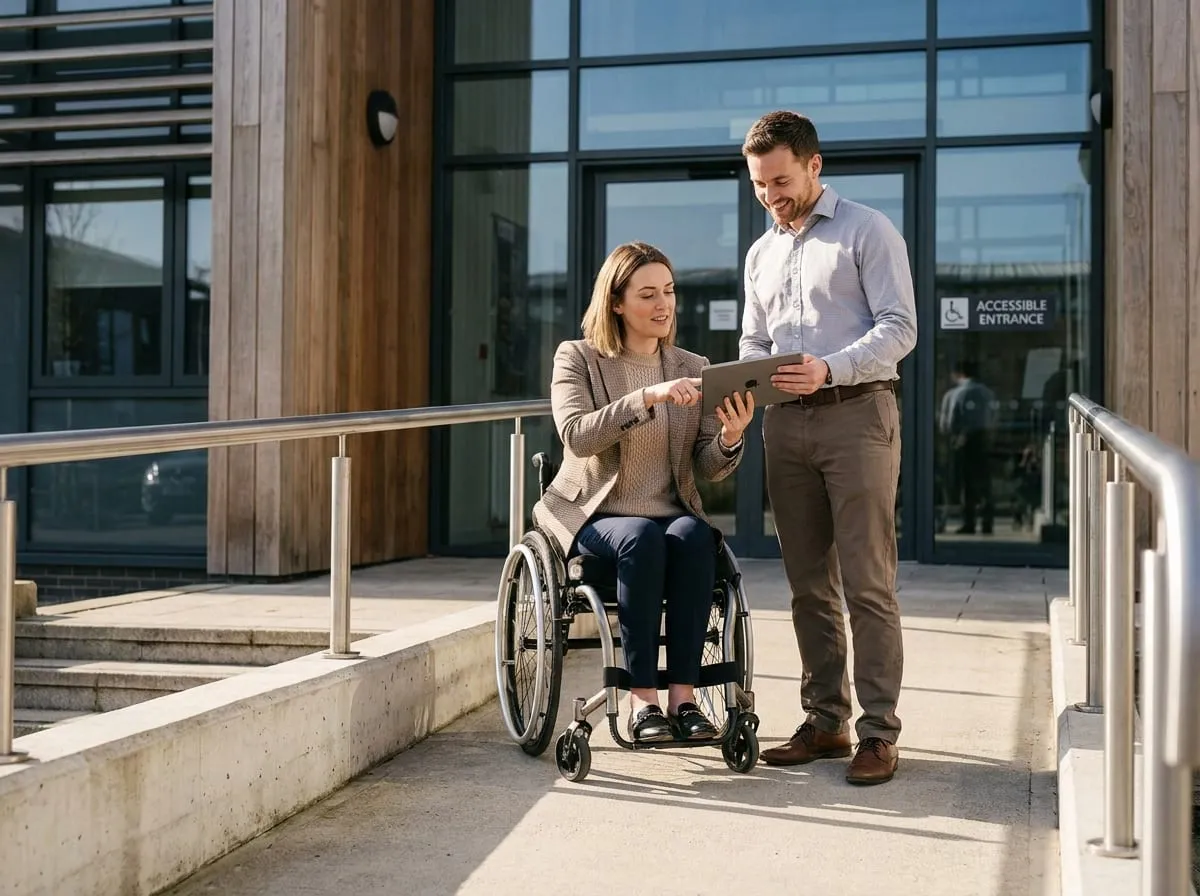
What the audit report contains

The report is written to be usable by three different readers: the general manager who needs to know what to fix first, the architect who needs dimensions, and the front-of-house manager who needs to brief a team on Monday. Every figure states the instrument used and the date recorded, so nothing in it has to be taken on trust.

  • A full attribute table with every measured dimension in centimetres, the instrument used, and the pass threshold alongside your result.
  • A photographic record of the entrance, thresholds, lift interiors, accessible toilet, transfer spaces and any obstruction found on the route.
  • The step-free approach assessed from the nearest accessible station or stop, with distances, gradients along the steepest metre, and surface classification.
  • Your accessibility score out of 100 with the calculation shown attribute by attribute, so you can see precisely which findings cost points.
  • A prioritised improvement roadmap ranking each change by access gained against relative cost, separating same-week fixes from capital works.
  • A rewritten accessibility statement you can publish on your own website, containing the figures rather than the adjectives.
What the audit report contains

Independence guarantee

This is the part we will not negotiate. Paying for an audit buys measurement, evidence and advice. It does not buy a score, a ranking, a favourable adjective or the removal of an inconvenient finding. If your building has two steps at the entrance, the profile will say so, in five languages, with the riser height. We are aware this makes the commercial conversation harder, and we accept that cost, because the only asset this site has is a reader’s reasonable belief that the figures were not arranged. Independence is not a value we display. It is the product.

  • A score is never adjusted, softened or withheld for a commercial reason, and no client sees a score before it is calculated.
  • There is no paid placement, sponsored ranking or promoted profile anywhere on the site, and audit clients receive no ordering advantage.
  • Findings are published as recorded. A client may correct a factual error with evidence; a client may not request the removal of an accurate one.
  • Certification, where issued, is earned on measurement and expires on a date. It cannot be purchased, renewed automatically, or kept after a building changes.

For destinations and public bodies

For a city, region or tourist board we can assess a portfolio of venues against the same protocol and report on the picture rather than the individual building: how much of the visitor offer is step-free, where the accessible transport network breaks down, which districts have no compliant accessible toilet within reasonable range, and which interventions would lift the most venues at once. The data is comparable between cities because the protocol does not change, which makes it usable for baselining, for tracking progress across a funding cycle, and for evidencing accessible tourism strategy with figures instead of intentions.

The business case for measured accessibility

About one in six people worldwide lives with a significant disability, and that figure understates the travelling market considerably. Add older travellers with reduced mobility or stamina, people recovering from surgery, families pushing buggies, and anyone with a hearing or visual impairment, and you are looking at a substantial share of visitors for whom a step at the door is a decision point. Commonly cited estimates put the annual spending power of disabled households in the UK alone in the hundreds of billions.

The party size is the part venues tend to miss. A disabled traveller rarely books alone: partners, companions, carers and children book with them, so losing one guest usually means losing two to four. Access-led bookings also behave well commercially. They are researched carefully, decided in advance, less price-driven than the average, more likely to travel outside peak season, and unusually loyal — a hotel that worked once gets booked again rather than gambled against.

There is a risk dimension as well, though it is the weaker argument. Accessibility legislation across Europe and beyond sets duties around reasonable adjustment and, increasingly, published information; a measured record of what your building offers and what you are improving is a more comfortable position than a general assurance. But the stronger case remains the plain one: a visitor who can find out in advance that they can get in will come, and one who cannot will book somewhere else without telling you why.

What certification does and does not mean

Certification from us records that a trained verifier measured your building on a stated date against a published protocol, and that the results reached a defined threshold. It is a statement about evidence and a moment in time. It does not certify that every visitor will have a good experience, that the lift will be working next Tuesday, or that your team will handle every request well. No badge can promise those things, and one that implies it is selling reassurance rather than information.

It also does not mean legal compliance. Building regulations and equality law vary by country and are matters for your regulator and your lawyers. Our protocol is written around what a traveller physically encounters, which sometimes sets a higher bar than a local code and occasionally a different one. A venue can be fully compliant and still score modestly with us, usually because the accessible route is technically present but practically awkward.

What certification does provide is a claim that can be checked. The protocol is public, the thresholds are published, the figures are yours to show, and the expiry date is visible. A traveller can see what was measured and when, and decide for themselves. That is a narrower promise than most accessibility badges make, and it is the reason ours is worth displaying.

Trabajar con nosotros: preguntas frecuentes

How much does an accessibility audit cost?

We quote a fixed fee at the scoping call, based on the number of buildings, floors and public routes in scope rather than an hourly rate. A single hotel or mid-sized attraction is a straightforward engagement; a station, a campus or a portfolio of venues is priced per site. The fee covers the visit, the evidenced report, the roadmap and the staff briefing pack.

Can we pay to improve our accessibility score?

No. The score is calculated from the recorded attributes using fixed weights, and no commercial relationship changes it. The only way it rises is for the underlying figures to change: widen the door, remove the step, install the accessible toilet, then ask us to remeasure. We publish the score we calculate, including when it is lower than a client hoped.

How long does an accessibility audit take?

On-site work runs from half a day for a single small venue to two days for a large or complex site. The full engagement, from scoping call to published profile, is typically four to six weeks, with most of that time spent on the report and your review of it rather than on the visit itself.

What happens if the audit finds serious accessibility problems?

You get the findings first, in full, with a prioritised plan for addressing them and an honest view of what is cheap and what is not. We do not withhold or soften results, but we also do not publish them as a verdict: the profile records what exists, and it is updated when you fix things. Several roadmap items are usually achievable within a week.

An independent accessibility audit, measured against a public protocol