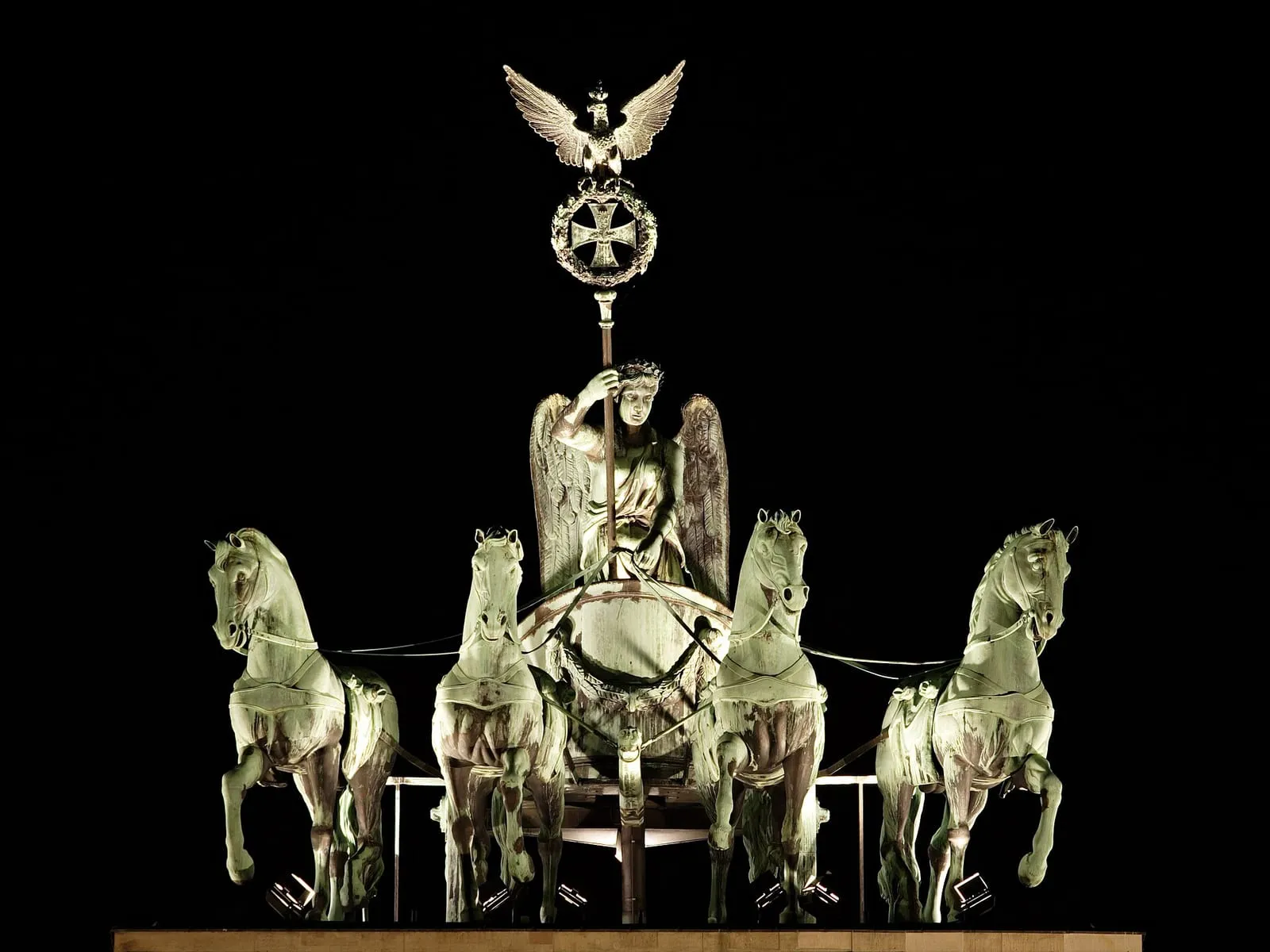
Brandenburg Gate
Mitte, Berlin · Last verified Jul 2026
An open, level plaza with no tickets, no doors and no steps — the difficulty is what Pariser Platz lacks rather than what it blocks.
The Brandenburg Gate is one of the rare major landmarks with nothing to negotiate. There is no ticket, no door, no threshold and no queue: the monument stands in the middle of a pedestrianised square, and you roll up to it. Pariser Platz is laid in small flat paving stones rather than the proud granite setts found elsewhere in Mitte, and the gradient across the square is around 1% — barely perceptible. Clear width is effectively unlimited except when an event stage is installed.
The approach matters more than the monument. Coming from the east along Unter den Linden gives you wide, smooth, level pavement the whole way. Coming from the north or south along Ebertstraße means crossing sections of rougher cobble, and the strip of setts marking the line of the Berlin Wall runs close by. Both U5 Brandenburger Tor and the S-Bahn station of the same name have lifts and sit roughly 150-220 m away, and the 100 bus stops directly on the square.
What Pariser Platz does not have is facilities. There is no public toilet block, no seating provided for visitors and no accessible parking on the square itself, which is closed to general traffic. The Akademie der Künste and the cafés along Unter den Linden are the practical stops, and if you have a Reichstag booking its visitor facilities are about 400 m north. Carrying a Euro-key is useful anywhere in Berlin for locked accessible WCs.
Crowds are the one variable that genuinely changes the experience. The gate is busy from mid-morning to late evening, with tour groups, street performers and photographers clustering under the central arches, and there is no quieter route through. Early morning is calm and the light is better; New Year and major public events close the area entirely and replace the flat paving with cable ramps and temporary barriers.
What the measurements mean
The main entrance is step-free. There is no dedicated accessible parking, so plan a drop-off instead.
Internal routes are around 400 cm wide, so two wheelchairs can pass each other.
No accessible toilet is available on site — plan a nearby alternative.
Surfaces are mixed, so expect some rougher stretches. The steepest gradient is around 1%, gentle enough for most users.
The nearest step-free station is Brandenburger Tor on the U5 line, about 150 m away.
Assistance animals are welcome. Staff are trained to assist. Seating is limited, which matters if standing or queuing is difficult.
What to expect
- Both Brandenburger Tor stations, U5 and S-Bahn, are step-free and within about 220 m.
- The plaza itself is small flat setts at roughly 1% gradient; the rougher cobbles start on Ebertstraße.
- There is no public toilet on the square — plan a stop at a nearby café or the Reichstag visitor facilities.
Getting there step-free
Full accessibility profile
Every attribute below is recorded against the same protocol, so figures are comparable between places. Values are marked Measured or Estimate, and the sources are listed above.Entrance & arrival
Accessible restroom
Surfaces & slopes
Getting there
Sensory & communication
Policies & assistance
Practical tips
- The visitBerlin tourist information office in the south gatehouse is step-free and staff can advise on nearby accessible toilets.
- Event build-ups on Pariser Platz introduce cable ramps and fencing — check for scheduled events if you need predictable ground.
- Passing through the central arch is not always possible; barriers are sometimes placed to manage crowds.
Brandenburg Gate: common accessibility questions
Is the Brandenburg Gate wheelchair accessible?
Yes. It stands on a pedestrianised, level square paved in small flat stones at roughly 1% gradient, with no ticket, door or step to negotiate. Both Brandenburger Tor stations are step-free within about 220 m, and the 100 bus stops on the square.
Are there accessible toilets at the Brandenburg Gate?
Not on the square itself. Pariser Platz has no public toilet block. The nearest reliable options are the cafés and cultural buildings on and around Unter den Linden, or the Reichstag visitor facilities about 400 m north if you have a dome booking. A Euro-key is worth carrying in Berlin.
When is the Brandenburg Gate least crowded?
Early morning, before about 9am. From mid-morning until late evening the arches fill with tour groups and performers, and there is no alternative route through. Major events close the square and replace the flat paving with temporary ramps and barriers, so check the events calendar if predictable ground matters.