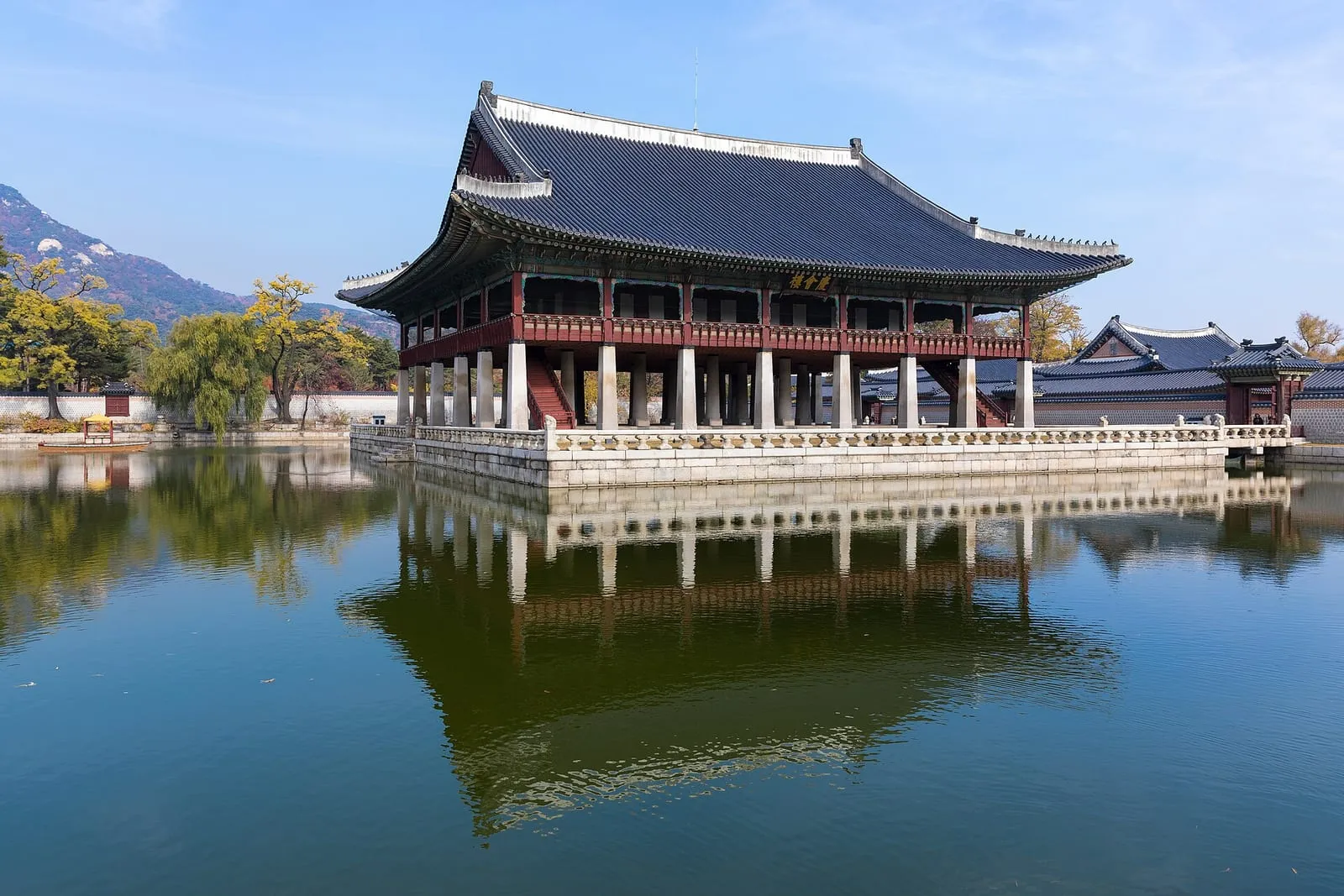
Gyeongbokgung Palace
Jongno, Seoul · Last verified Jul 2026
Ramps cross the thresholds and free wheelchairs are provided, but the courtyards are coarse gravel and irregular stone, and the historic halls cannot be entered.
Gyeongbokgung is the most important of Seoul's five royal palaces and one of the more honest access cases in the city. The Korea Heritage Service has fitted ramps at the thresholds and low walls that run throughout the compound, provides free wheelchair loan, accessible parking and accessible toilets, and admits a disabled visitor and one companion free. Staff will help. None of that changes the fact that this is a 14th-century palace laid out for ceremony rather than circulation.
The surfaces are the main obstacle. The great courtyards, including the central Geunjeongjeon plaza in front of the throne hall, are laid with coarse gravel and large irregular stone slabs that are heavy going in a manual chair and jarring in a powerchair. Unpaved sections connect several of the outer courtyards. Published reviews consistently describe some of the site ramps as steep enough that an unassisted manual user will need a push, and gradients around 9% are typical at the level changes.
The buildings themselves are not enterable. Adding ramps to the timber halls would compromise structures that are themselves the protected heritage, so the honest description is that you experience the palace from the outside: the gates, the courtyards, the exteriors of Geunjeongjeon and Gyeonghoeru, and the walk to Hyangwonjeong pavilion. The one exception is the National Folk Museum within the grounds, which is a modern building and fully accessible, and is the place to plan an indoor break.
Practically, the approach is good. Gyeongbokgung station on Line 3 has a lift and Exit 5 is roughly 200 m from the entrance; Gwanghwamun on Line 5 is step-free at around 650 m. The main entrance itself is wide with no steps but the approach slope is noticeably steep, so take it slowly. Audio guides are available, tactile paving is present at the entrance area but not across the site, and there is no sensory map. Allow two hours and accept that you will cover ground rather than go indoors.
What the measurements mean
The main entrance is step-free. The main door measures 200 cm, which is generous for any wheelchair or mobility scooter. Accessible parking is available on site or immediately adjacent.
Internal routes are around 250 cm wide, so two wheelchairs can pass each other.
There is an accessible toilet. Grab bars are fitted. Turning space is about 160 cm, enough for a full turn in most wheelchairs.
Surfaces are gravel — hard going for a manual chair and small castors. The steepest gradient reaches about 9% — steep enough to need assistance or a powered chair.
The nearest step-free station is Gyeongbokgung (Exit 5) on the 3 line, about 200 m away.
Sensory and communication support includes audio guide, braille signage and tactile paving.
A companion or carer is admitted free. Assistance animals are welcome. Staff are trained to assist. Seating and rest points are available along the route.
What to expect
- Line 3 Gyeongbokgung station, Exit 5, is step-free and about 200 m from the palace entrance.
- Free wheelchair loan, accessible parking and accessible toilets, including single-user facilities at Hongbokjeon.
- The Geunjeongjeon courtyard is large uneven stone; several site ramps are steep enough to need a push.
Getting there step-free
Full accessibility profile
Every attribute below is recorded against the same protocol, so figures are comparable between places. Values are marked Measured or Estimate, and the sources are listed above.Entrance & arrival
Accessible restroom
Surfaces & slopes
Getting there
Sensory & communication
Policies & assistance
Practical tips
- Admission is free for a disabled visitor and one companion; documentation is checked at the ticket window.
- The National Folk Museum inside the grounds is fully accessible and free — a good indoor stop.
- The changing of the guard draws dense crowds at the main gate; watch from the side rather than the front.
Practical facilities
Compiled from the venue’s own published accessibility information, not measured by us. Confirm anything critical before you travel.
- Disabled admission
- Free for disabled visitors
- Companion free
- Proof required: Identification confirming registered disability, checked at Heungnyemun Gate.
Visitors with a severe disability enter free with one companion and visitors with a mild disability enter free; no reservation is required.
- Assistance you can book
- No fixed notice period published
- Contact: +82 2-3700-3900
The Gyeongbokgung Palace Management Office handles visitor accessibility enquiries.
Sources: Korea Heritage Service — Royal Palaces admission information (retrieved August 10, 2026)
Gyeongbokgung Palace: common accessibility questions
Is Gyeongbokgung Palace wheelchair accessible?
The grounds are navigable with caveats and the buildings are not. Ramps cross the site's thresholds and low walls, and free wheelchair loan, accessible parking and accessible toilets are provided. But the courtyards are coarse gravel and uneven stone, several ramps are steep, and the historic halls cannot be entered because ramps would damage the structures.
Can you go inside the buildings at Gyeongbokgung in a wheelchair?
Generally no. The timber halls are protected structures and cannot be ramped, so access is limited to the exteriors, gates and courtyards. The National Folk Museum within the palace grounds is a modern, fully accessible building and is the one place on site you can comfortably go indoors.
How do you get to Gyeongbokgung step-free?
Gyeongbokgung station on Line 3 has lift access, and Exit 5 is roughly 200 m from the palace entrance. Gwanghwamun station on Line 5 is a step-free alternative at about 650 m. The entrance itself is wide and step-free, though the approach slope is steep enough to take carefully.