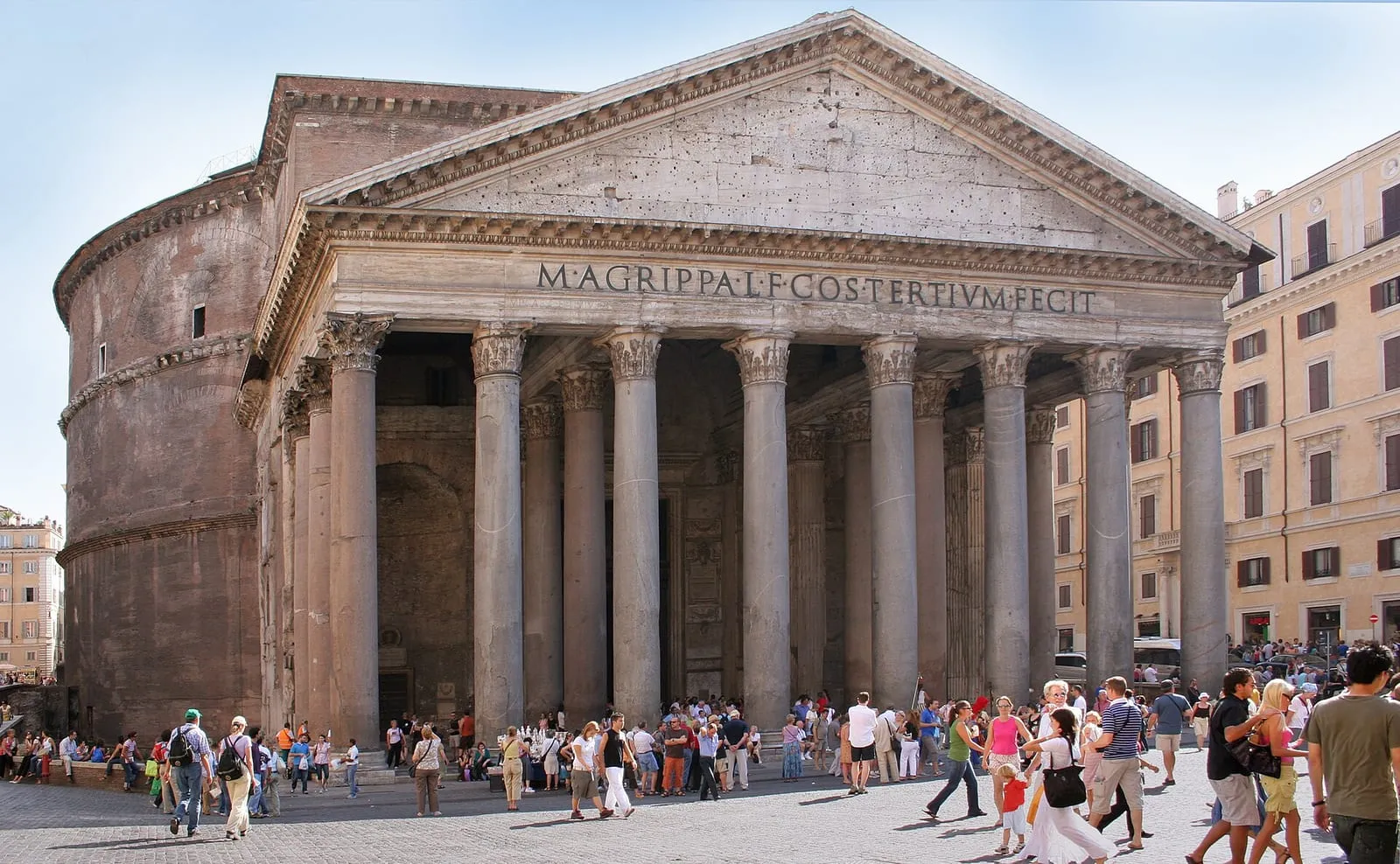
Pantheon
Pigna, Rome · Last verified Jul 2026
A level interior under the oculus, entered by an external ramp on the Via della Minerva side, ringed by some of the roughest cobbles in Rome.
The barrier at the Pantheon is not the building, it is the last 300 m. Piazza della Rotonda and every lane feeding into it are paved in sampietrini, the small basalt setts that Rome sets in sand, and here they are as worn and dished as anywhere in the city. The piazza also sits a little lower than the streets around it, so most approaches involve a short cross-slope over rough stone. Coming in along Via del Seminario or Via della Minerva gives the smoother line.
The official guidance is specific: visitors with disabilities or reduced mobility enter via the external ramp on the Via della Minerva side. The main portico has a threshold step, so the ramp is the route rather than a courtesy. Past the great bronze doors — about 140 cm of clear width between them — you are straight into the rotunda with no further level change, which is the part that surprises people who assumed a second-century temple would defeat them.
Inside, the floor is essentially one plane, 43.3 m across, with the oculus 43 m overhead. The ancient marble paving is patterned, worn, and gently dished towards the drains at the centre, where rain still falls through the opening, so the surface is uneven rather than rough. Seating is very limited and there is no accessible toilet, which together set a practical ceiling on how long a visit can comfortably last. The Pantheon is also a working basilica, so services close it to visitors.
Transport is the weakest part of the profile. There is no accessible metro nearby: Barberini, roughly 1.1 km away, is one of the four Line A stations ATAC lists as not accessible, and so is Spagna. The dependable option is the bus, since the entire ATAC fleet is ramped, with stops on Corso Rinascimento about 300 m away. Tram 8 reaches Largo di Torre Argentina, but only around 70% of Rome's trams have a level floor.
What the measurements mean
The main entrance is step-free. The main door measures 140 cm, which is generous for any wheelchair or mobility scooter. There is no dedicated accessible parking, so plan a drop-off instead.
Internal routes are around 250 cm wide, so two wheelchairs can pass each other.
No accessible toilet is available on site — plan a nearby alternative.
Surfaces are cobblestones — hard going for a manual chair and small castors. The steepest gradient is around 3%, gentle enough for most users.
The nearest step-free station is Corso Rinascimento on the 30 line, about 300 m away. Note that Largo di Torre Argentina, Barberini is not step-free, despite being close.
A companion or carer is admitted free. Assistance animals are welcome. Staff are trained to assist. Seating is limited, which matters if standing or queuing is difficult. Booking ahead is advisable to secure accessible entry.
What to expect
- Visitors with disabilities or reduced mobility enter via the external ramp on the Via della Minerva side, not the main portico.
- A ticket and timed slot are required; book ahead rather than joining the on-site queue.
- There is no accessible toilet inside — plan a stop before you arrive.
Getting there step-free
Full accessibility profile
Every attribute below is recorded against the same protocol, so figures are comparable between places. Values are marked Measured or Estimate, and the sources are listed above.Entrance & arrival
Accessible restroom
Surfaces & slopes
Getting there
Sensory & communication
Policies & assistance
Practical tips
- Free admission for a disabled visitor and companion at this state site still needs a booked slot.
- Rain falls through the oculus and the central floor gets slippery; the drains sit in a shallow dish.
- Early morning is both quieter and easier — the piazza fills with tables and crowds from mid-morning.
Pantheon: common accessibility questions
Is the Pantheon in Rome wheelchair accessible?
Yes, once you reach it. Visitors with disabilities or reduced mobility enter by the external ramp on the Via della Minerva side, and the interior is essentially one level under the oculus with wide doors. The real difficulty is the sampietrini paving of Piazza della Rotonda, and there is no accessible toilet inside.
Which entrance of the Pantheon do wheelchair users use?
The external ramp on the Via della Minerva side, as the site's own guidance states. The main portico entrance has a threshold step. Once through the bronze doors, roughly 140 cm of clear width, there is no further level change into the rotunda.
How do wheelchair users get to the Pantheon?
By bus. The whole ATAC bus fleet has ramps and a wheelchair space, and stops on Corso Rinascimento are about 300 m away. There is no accessible metro nearby — Barberini and Spagna on Line A are both on ATAC's inaccessible list — and only about 70% of Rome's trams have level floors.