Museo Reina Sofía
Atocha, Madrid · Last verified Jul 2026
Practically every public area is reachable, with the Sabatini entrance and exterior glass lifts doing the work — the nearest metro station, though, has no lift.
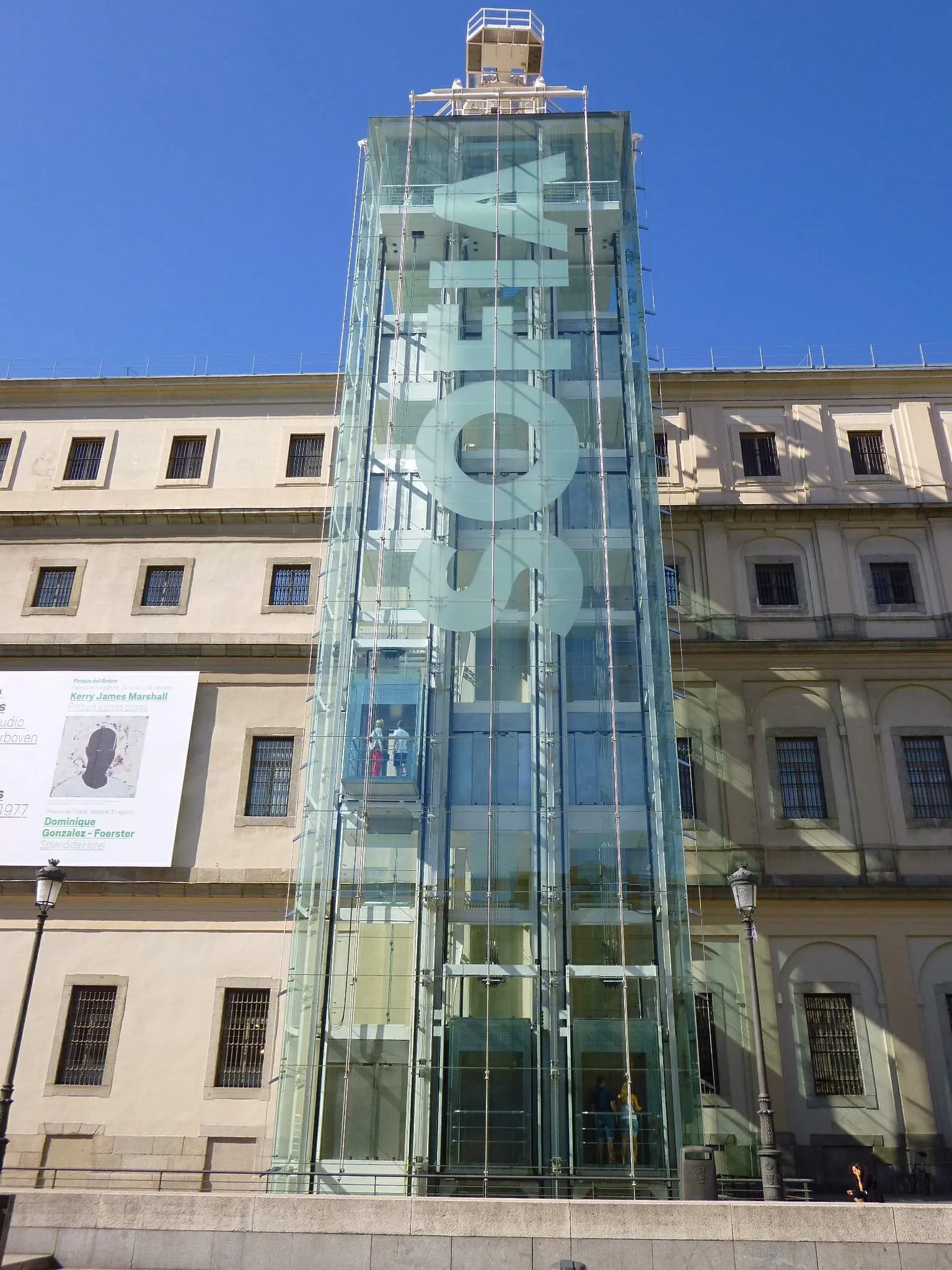
The Reina Sofía occupies an eighteenth-century hospital, and the 1980s conversion solved its vertical problem in the most visible way possible: three glass and steel lift towers bolted to the exterior of the Sabatini building. They are the museum’s signature and also its accessibility backbone, carrying visitors to the collection floors from a wheelchair-accessible entrance on Calle Santa Isabel. The museum states that practically all public areas are reachable by wheelchair.
Inside, the old hospital’s proportions work in your favour. The corridors that ring each floor are wide — clear widths in the region of 280 cm — and level, with ramps where the original floor plates step. Adapted toilets, seating and cloakroom access are provided, and the auditorium is entered from the lobby without slopes, with two reserved wheelchair areas in the central rows rather than at the back, which is a small detail that says a lot.
Provision for visual and hearing impairment is well developed. The museum lends folding cane seats alongside wheelchairs at the Visitor Information Desk, publishes braille brochures, offers audio guides with audio description, and runs tactile and descriptive visits of selected works from the collection, some accompanied by museum educators with ONCE Foundation support. Booking these goes through accesibilidad@museoreinasofia.es rather than the general ticket line, and the museum answers on the same address for any other access question about a specific visit.
The transport picture repeats Madrid’s central problem. Estación del Arte on L1 is barely 150 m from the door but has neither lift nor escalator, so the practical arrivals are Atocha Cercanías at around 500 m, which is step-free and staffed, or the ramped EMT buses along Ronda de Atocha. The approach itself is level granite paving with reliable dropped kerbs. Guernica’s room is the one place where crowding genuinely restricts a wheelchair’s sightline — come at opening or late afternoon.
What the measurements mean
The main entrance is step-free. The main door measures 130 cm, which is generous for any wheelchair or mobility scooter. There is no dedicated accessible parking, so plan a drop-off instead.
The lift cabin is 150 × 180 cm, enough room for a powerchair and a companion together. Its door opening is 110 cm. Internal routes are around 280 cm wide, so two wheelchairs can pass each other.
There is an accessible toilet. Grab bars are fitted. Turning space is about 170 cm, enough for a full turn in most wheelchairs.
Surfaces are smooth & even, which rolls easily. The steepest gradient is around 2%, gentle enough for most users.
The nearest step-free station is Madrid Atocha (Cercanías), about 500 m away. Note that Estación del Arte is not step-free, despite being close.
Sensory and communication support includes audio guide and braille signage.
A companion or carer is admitted free. Assistance animals are welcome. Staff are trained to assist. Seating and rest points are available along the route.
What to expect
- Enter through the Sabatini building on Calle Santa Isabel; the exterior glass lift towers serve the collection floors.
- Wheelchairs and folding cane seats can be borrowed at the Visitor Information Desk.
- Estación del Arte (L1) is only 150 m away but has no lift — use Atocha Cercanías, about 500 m, or a ramped bus.
Getting there step-free
Full accessibility profile
Every attribute below is recorded against the same protocol, so figures are comparable between places. Values are marked Measured or Estimate, and the sources are listed above.Entrance & arrival
Elevators & lifts
Accessible restroom
Surfaces & slopes
Getting there
Sensory & communication
Policies & assistance
Practical tips
- Admission is free for visitors with a disability; documentation is required.
- The Nouvel extension around the courtyard is level throughout and much quieter than the Sabatini collection floors.
- Reserve tactile or descriptive visits well ahead — they run to a schedule rather than on demand.
Practical facilities
Compiled from the venue’s own published accessibility information, not measured by us. Confirm anything critical before you travel.
- Wheelchair loan
- Free
- No booking needed
Wheelchairs and folding cane seats are lent by the visitor assistance team and requested at the Sabatini or Nouvel information points.
- Disabled admission
- Free for disabled visitors
- Companion free
- Proof required: Official accreditation showing an expiry date, together with an ID card or passport.
Tickets are collected at the museum ticket offices on the day of the visit; the accompanying person is exempt from the fee when support is needed.
- Assistance you can book
- No fixed notice period published
- Contact: accesibilidad@museoreinasofia.es, +34 91 774 1000 ext. 289932
Practically all public areas are wheelchair accessible via ramps and lifts.
Sources: Museo Reina Sofía — Accessibility (retrieved August 10, 2026) · Museo Reina Sofía — Free access and discounts (retrieved August 10, 2026)
Museo Reina Sofía: common accessibility questions
Is the Reina Sofía museum wheelchair accessible?
Yes. Entry through the Sabatini building is wheelchair accessible, the exterior glass lift towers reach the collection floors, and the museum states that practically all public areas are accessible, with ramps, adapted toilets, seating and cloakroom access. The auditorium has level entry and two reserved central-row areas.
How do wheelchair users reach the Reina Sofía by public transport?
Not through the nearest station. Estación del Arte on L1 is 150 m away but has no lift. Use Atocha Cercanías, about 500 m over level paving and step-free with staffed assistance, or take a low-floor EMT bus along Ronda de Atocha.