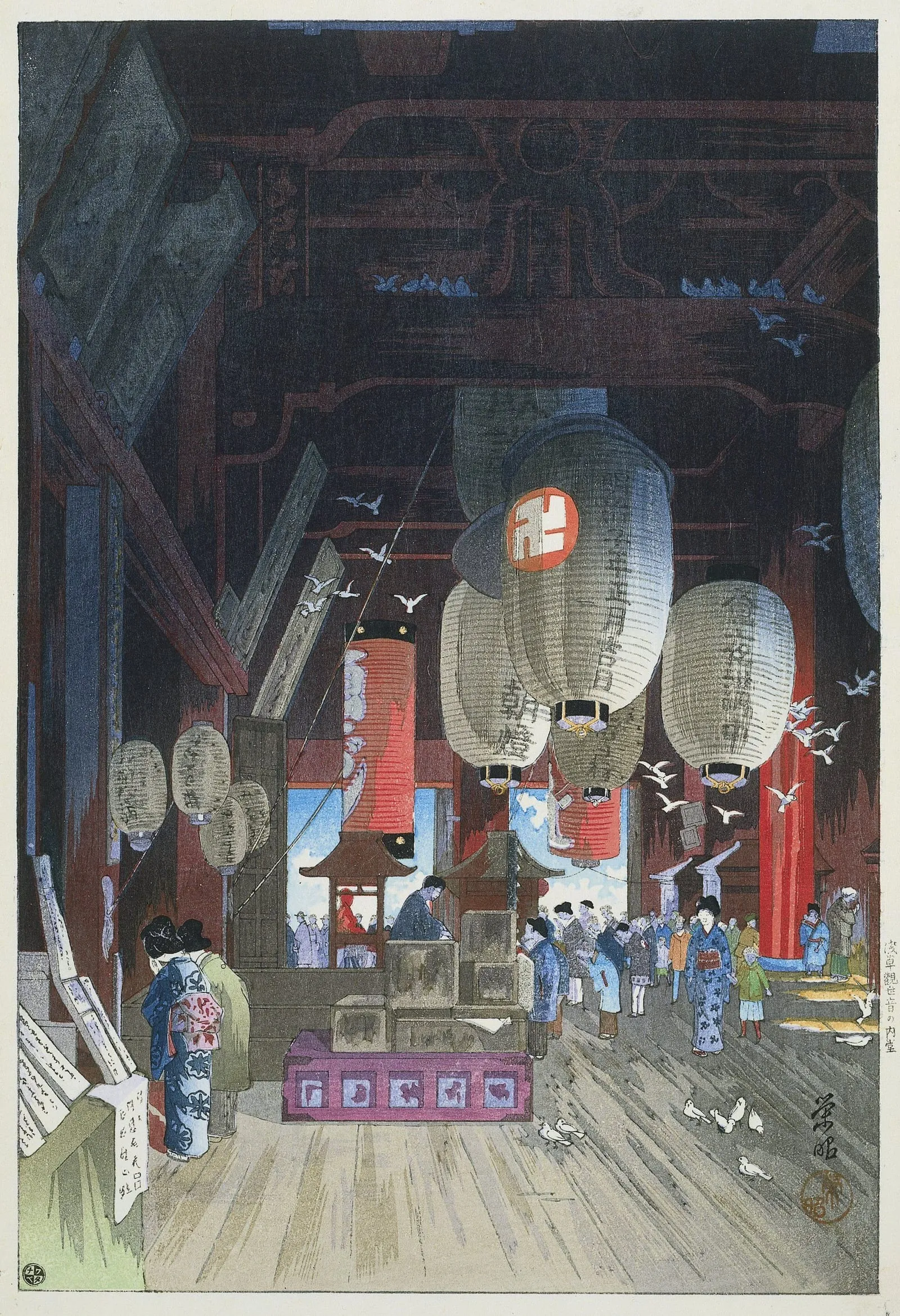
Sensō-ji
Asakusa, Tokyo · Last verified Jul 2026
Tokyo's oldest temple sits on flat ground with a 4 m-wide approach, and the main hall's worship floor is reached by a side ramp and a small lift rather than the front steps.
Sensō-ji works better than most historic religious sites, mainly because the ground is flat. From Kaminarimon gate, up the Nakamise-dōri shopping street and through Hōzōmon to the main hall, the whole 250 m approach is level paving roughly 4 m wide with no steps on the central line. That single fact removes the usual temple problem, where the site is reachable but the last hundred metres are not.
The main hall is where the compromise sits. The grand frontal staircase has no ramp and never will. Instead there is a side ramp on the left as you face the building, leading up to the worship area, and a small lift immediately to the left of the hall. Both work, and staff and other visitors will point you to them, but neither is signposted in English and the lift is modest at roughly 110 × 140 cm with an 80 cm door, which rules out larger powerchairs.
Around the hall, provision is decent. Multipurpose toilets with grab bars and about 165 cm of turning space are located near Hōzōmon, to the right of the Treasure House gate, and at the rear of the main hall. The five-storey pagoda, Asakusa Shrine and several sub-halls keep their steps and cannot be entered, and the garden behind Denbōin is only occasionally open with mixed surfaces.
The bigger practical issue is crowding. Nakamise-dōri is one of Tokyo's busiest tourist streets, and between about 10:00 and 16:00 the 4 m width fills with people moving in both directions, which makes a wheelchair slow and stressful rather than blocked. Arriving before 09:00 changes the experience completely: the grounds are open, quiet and genuinely easy, and the main hall opens at 06:00 for most of the year.
What the measurements mean
The main entrance is step-free. The main door measures 200 cm, which is generous for any wheelchair or mobility scooter. Accessible parking is available on site or immediately adjacent.
The lift cabin is 110 × 140 cm, enough room for a powerchair and a companion together. Its door opening is 80 cm. Internal routes are around 400 cm wide, so two wheelchairs can pass each other.
There is an accessible toilet. Grab bars are fitted. Turning space is about 165 cm, enough for a full turn in most wheelchairs.
Surfaces are paved, which rolls easily. The steepest gradient is around 2%, gentle enough for most users.
The nearest step-free station is Asakusa on the Ginza line, about 400 m away.
A companion or carer is admitted free. Assistance animals are welcome. Seating and rest points are available along the route.
What to expect
- The front steps to the main hall are unavoidable — use the ramp on the left as you face it, or the lift beside it.
- The offering box has two steps with a ramp to the left, so you can make an offering from a chair.
- Accessible toilets sit near Hōzōmon gate, to the right of the Treasure House gate and behind the main hall.
Getting there step-free
Full accessibility profile
Every attribute below is recorded against the same protocol, so figures are comparable between places. Values are marked Measured or Estimate, and the sources are listed above.Entrance & arrival
Elevators & lifts
Accessible restroom
Surfaces & slopes
Getting there
Sensory & communication
Policies & assistance
Practical tips
- Asakusa station is step-free on the Ginza, Toei Asakusa and Tobu lines, each 400-500 m away over level ground.
- Nakamise-dōri stalls narrow the usable width considerably at peak hours; the parallel side streets are quieter.
- The temple publishes no accessibility page, so the Tokyo Metropolitan Government barrier-free route guide is the better source.
Sensō-ji: common accessibility questions
Is Sensō-ji temple wheelchair accessible?
The grounds are, and easily: the approach from Kaminarimon to the main hall is flat, wide paving with no steps. The main hall's front staircase has no ramp, but a side ramp on the left and a small lift beside the hall reach the worship area. The pagoda and several sub-halls remain stepped.
Is there a lift at Sensō-ji main hall?
Yes, a small one immediately to the left of the main hall, alongside a side ramp that also reaches the worship floor. The lift is modest at roughly 110 × 140 cm with an 80 cm door, so large powerchairs may not fit; the ramp is the alternative. Neither is well signposted in English.
Where are the accessible toilets at Sensō-ji?
There are three convenient options: near Hōzōmon gate, roughly halfway along the approach; to the right of the Treasure House gate; and at the back of the main hall. All are multipurpose toilets with grab bars and around 165 cm of turning space.