Ueno Park
Taito, Tokyo · Last verified Jul 2026
A flat museum quarter reached in 150 m from a step-free station exit, wrapped around a hillside that hides stairs and 7% ramps between levels.
Ueno Park is really two places stacked on top of each other, and knowing which one you are entering decides your day. The upper plateau holds the Tokyo National Museum, the National Museum of Nature and Science, the National Museum of Western Art and Ueno Zoo, and it is essentially flat, with paths 3 m wide or more and firm surfaces. The lower area around Shinobazu Pond is also level. Between the two sit stairs and a pair of access roads at roughly 7%, which is where the trouble is.
The approach solves most of it. JR Ueno station's Park Exit is step-free by lift and opens onto the upper plateau about 150 m from the museum forecourts, so if you arrive that way you never meet the slope. Tokyo Metro's Ueno station is also step-free and roughly 350 m out, and Keisei-Ueno is a similar distance, but both deliver you to the lower level, which means finding one of those ramps to get up.
Facilities across the park are solid rather than remarkable. Multipurpose toilets with grab bars and around 180 cm of turning space are distributed near the main museums and the pond, accessible parking sits beside the zoo entrance, and each of the big museums lends wheelchairs free at its cloakroom. Surfaces are a mix of asphalt, compacted decomposed granite and stone paving, and the granite sections get soft and rutted after heavy rain.
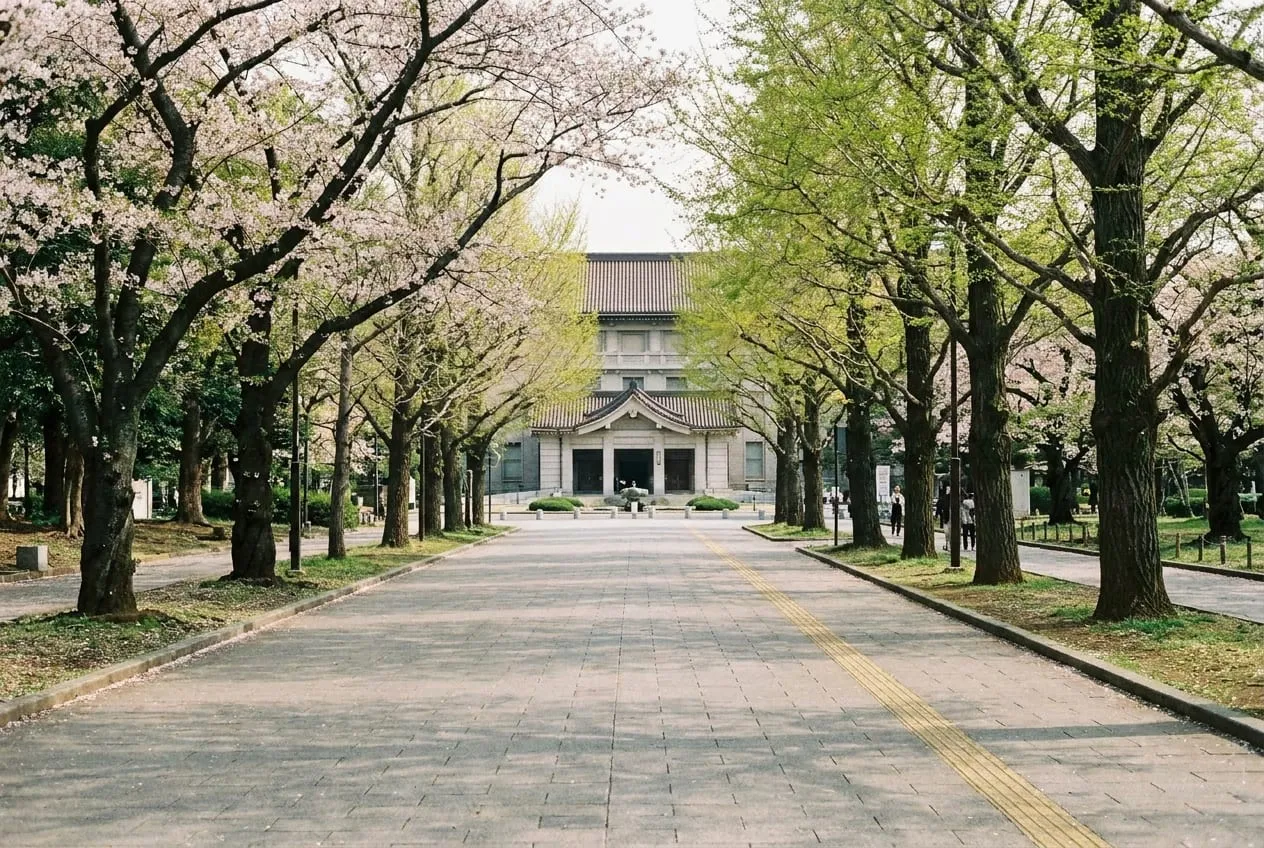
Two practical caveats. There is no park-wide audio guide or sensory map, so wayfinding for blind visitors relies on the tactile paving that runs along the main paths and up to the museum entrances rather than on any published route. And in cherry blossom season the central avenue becomes so densely packed with people and picnic tarpaulins that a wheelchair genuinely cannot pass — plan a different week or a different park.
What the measurements mean
The main entrance is step-free. The main door measures 200 cm, which is generous for any wheelchair or mobility scooter. Accessible parking is available on site or immediately adjacent.
The lift cabin is 140 × 170 cm, enough room for a powerchair and a companion together. Its door opening is 90 cm. Internal routes are around 300 cm wide, so two wheelchairs can pass each other.
There is an accessible toilet. Grab bars are fitted. Turning space is about 180 cm, enough for a full turn in most wheelchairs.
Surfaces are mixed, so expect some rougher stretches. The steepest gradient reaches about 7%, which is noticeable in a manual chair.
The nearest step-free station is Ueno (Park Exit) on the JR Yamanote line, about 150 m away.
Sensory and communication support includes braille signage and tactile paving.
A companion or carer is admitted free. Assistance animals are welcome. Staff are trained to assist. Seating and rest points are available along the route.
What to expect
- Use JR Ueno's Park Exit — it puts you on the park's upper level with no climb at all.
- The park publishes a downloadable barrier-free map; the on-site maps also mark a dotted accessible route.
- Two internal access roads are steep enough to avoid in a manual chair; the museum plateau itself is level.
Getting there step-free
Full accessibility profile
Every attribute below is recorded against the same protocol, so figures are comparable between places. Values are marked Measured or Estimate, and the sources are listed above.Entrance & arrival
Elevators & lifts
Accessible restroom
Surfaces & slopes
Getting there
Sensory & communication
Policies & assistance
Practical tips
- The Tokyo National Museum, Nature and Science, and the Museum of Western Art are all step-free with lifts and loaned wheelchairs.
- Multipurpose toilets are marked on the park's barrier-free map; the ones by the pond are the most spacious.
- Weekday mornings are calm; weekend afternoons and blossom season are effectively impassable on the main avenue.
Ueno Park: common accessibility questions
Is Ueno Park wheelchair accessible?
The museum plateau and the pond area are both flat with wide firm paths and multipurpose toilets. Moving between the two levels means stairs or one of two access roads at around 7%, which is hard work in a manual chair. Arriving via JR Ueno's Park Exit lands you on the upper level and avoids the climb entirely.
Which station exit is best for Ueno Park in a wheelchair?
JR Ueno station's Park Exit. It is step-free by lift and opens directly onto the upper plateau roughly 150 m from the museums. Tokyo Metro Ueno and Keisei-Ueno are also step-free but arrive at the lower level, leaving you to negotiate a ramp up.
Are the toilets in Ueno Park accessible?
Yes. Multipurpose toilets with grab bars and roughly 180 cm of turning space are located near the main museum entrances and around Shinobazu Pond, and they are marked on the park's downloadable barrier-free map. Individual sizes vary, so the pond-side facilities are the more generous option.