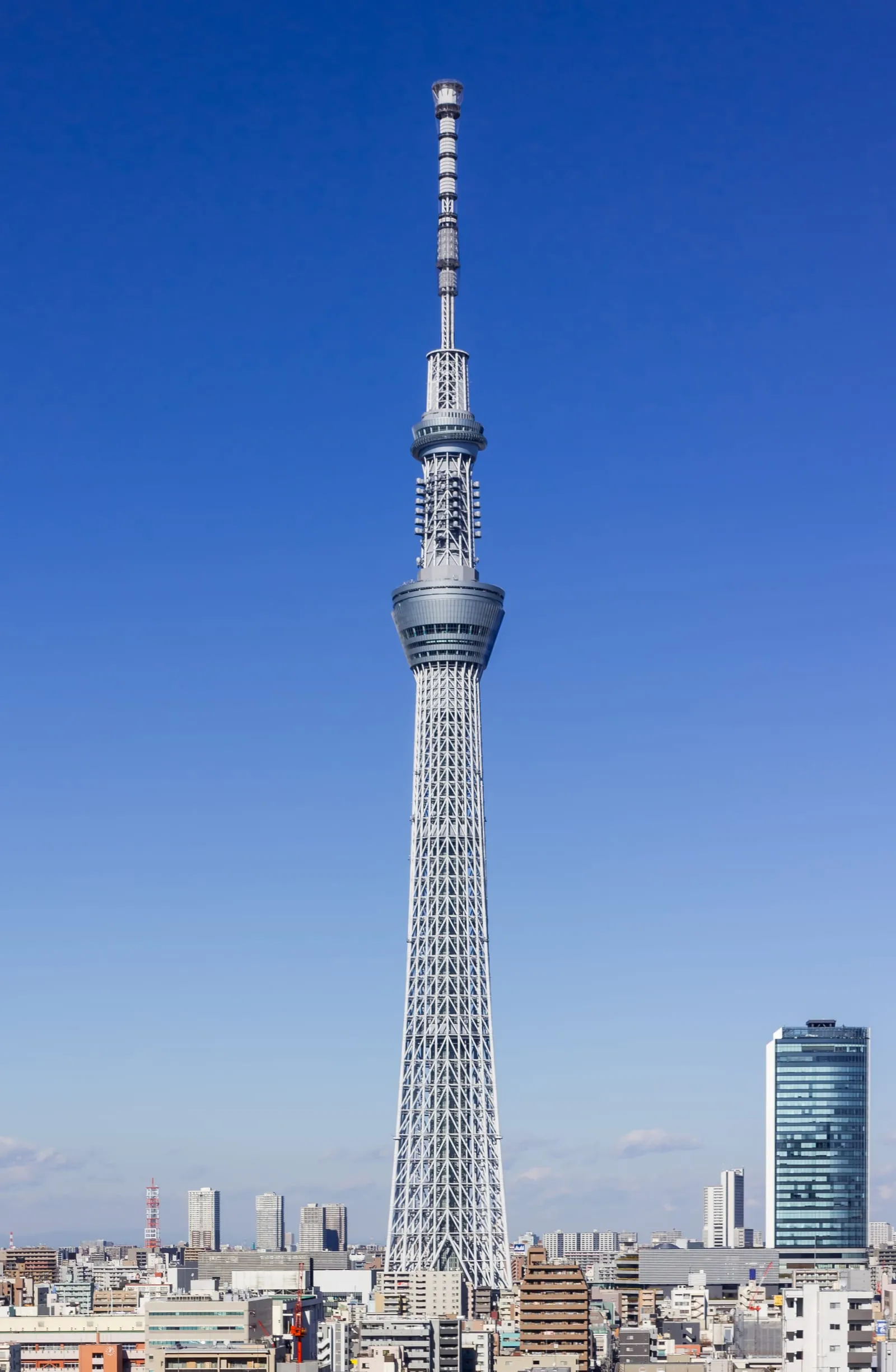
Tokyo Skytree
Sumida, Tokyo · Last verified Jul 2026
A 2012 tower built to modern barrier-free standards: lifts to both observation decks, accessible toilets on every level including 450 m, and free wheelchair loan.
Tokyo Skytree is the easy answer to "what can we do that will definitely work". Completed in 2012 under Japan's barrier-free building rules, it was designed for wheelchair access rather than adapted for it, and the whole visitor route from station to the 450 m Tembo Galleria is step-free. Hallways are flat and wide, floor surfaces are smooth throughout, and there is no point on the route where a staff member has to improvise a solution.
The vertical arrangement is unusually well documented. High-speed lifts serve the Tembo Deck at 350 m, a second lift continues to the Tembo Galleria at 450 m, and a dedicated priority lift links the three deck floors at 340, 345 and 350 with an internal cabin of 160 × 150 cm and a 240 cm ceiling. Accessible toilets are at B1F, 1F, 4F, 5F, all three Tembo Deck levels and at 450 m, and several include ostomy fittings.
Service provision matches the hardware. Wheelchairs are loaned free at the 1F group ticket counter and 4F information desk in both standard (40 cm seat, 100 kg) and wide (44 cm seat, 130 kg) versions. Ticket and information counters are height-adjusted for seated use, tactile paving and audio guidance run through the concourses, assistance dogs are welcome, and first aid rooms with AED are on several floors. A disability discount applies at the 4F counter with documentation.
The approach is equally solid. Tobu's Tokyo Skytree station sits about 100 m from the 4F main entrance and Tokyo Metro's Oshiage station about 250 m, both step-free, and the operator publishes video walkthroughs of the barrier-free route from each. The Solamachi complex beneath the tower is a large multi-level mall with plentiful lifts, which is convenient for eating and sheltering but adds real indoor distance — budget for it. What is missing is sensory support: no quiet hours, no hearing loop, and the decks get crowded and noisy at sunset.
What the measurements mean
The main entrance is step-free. The main door measures 180 cm, which is generous for any wheelchair or mobility scooter. Accessible parking is available on site or immediately adjacent.
The lift cabin is 160 × 150 cm, enough room for a powerchair and a companion together. Its door opening is 110 cm. Internal routes are around 300 cm wide, so two wheelchairs can pass each other.
There is an accessible toilet. Grab bars are fitted. Turning space is about 200 cm, enough for a full turn in most wheelchairs.
Surfaces are smooth & even, which rolls easily. The steepest gradient is around 0%, gentle enough for most users.
The nearest step-free station is Tokyo Skytree on the Tobu Skytree line, about 100 m away.
Sensory and communication support includes audio guide, braille signage and tactile paving.
A companion or carer is admitted free. Assistance animals are welcome. Staff are trained to assist. Seating and rest points are available along the route. Booking ahead is advisable to secure accessible entry.
What to expect
- Lifts reach both the Tembo Deck at 350 m and the Tembo Galleria at 450 m — no stairs on either route.
- A dedicated priority lift links deck floors 340, 345 and 350, with a cabin of 160 × 150 cm.
- Free standard (40 cm seat) and wide (44 cm seat) wheelchairs at the 1F group counter and 4F information desk.
Getting there step-free
Full accessibility profile
Every attribute below is recorded against the same protocol, so figures are comparable between places. Values are marked Measured or Estimate, and the sources are listed above.Entrance & arrival
Elevators & lifts
Accessible restroom
Surfaces & slopes
Getting there
Sensory & communication
Policies & assistance
Practical tips
- Book a timed slot online; sunset slots are the busiest and the lifts queue longest then.
- Staff will move disabled guests to the front of the ticket queue if you speak to them on arrival.
- The 450 m Galleria is a sloping spiral ramp rather than a flat floor, gentle but continuous.
Practical facilities
Compiled from the venue’s own published accessibility information, not measured by us. Confirm anything critical before you travel.
- Wheelchair loan
- Free
- No booking needed
A limited number of wheelchairs is lent free of charge for use inside the facility; advance reservations are not accepted and visitors ask a staff member on the day.
- Accessible toilets
- Count not published
- No Changing Places facility published
- Throughout the tower and Skytree Town, including ostomate-equipped cubicles.
Some accessible restrooms have care beds usable by adults.
- Arrival & parking
- Drop-off: Not published.
- Accessible parking: Not published.
A priority lift links Tembo Deck levels 340, 345 and 350, with a car 1600 mm wide and 1500 mm deep and a 1000 mm door opening.
Sources: TOKYO SKYTREE — Facilities and services (retrieved August 10, 2026) · TOKYO SKYTREE — Frequently asked questions (retrieved August 10, 2026)
Tokyo Skytree: common accessibility questions
Is Tokyo Skytree wheelchair accessible?
Yes, fully. Lifts reach both the Tembo Deck at 350 m and the Tembo Galleria at 450 m with no stairs anywhere on the route, corridors are flat and wide, and accessible toilets are on every visitor floor including 450 m. Wheelchairs are loaned free, and counters are height-adjusted for seated use.
Can you borrow a wheelchair at Tokyo Skytree?
Yes, free of charge, at the 1F group ticket counter and the 4F information desk. Two sizes are offered: standard with a 40 cm seat and 100 kg capacity, and wide with a 44 cm seat and 130 kg capacity. Availability is first-come, so arrive earlier in the day if you need the wide chair.
How do you reach Tokyo Skytree step-free?
Tobu's Tokyo Skytree station is step-free and about 100 m from the 4F main entrance; Oshiage station on the Hanzomon line is step-free at roughly 250 m. The operator publishes video guides showing the barrier-free walking route from each station, which is worth watching before you travel.